
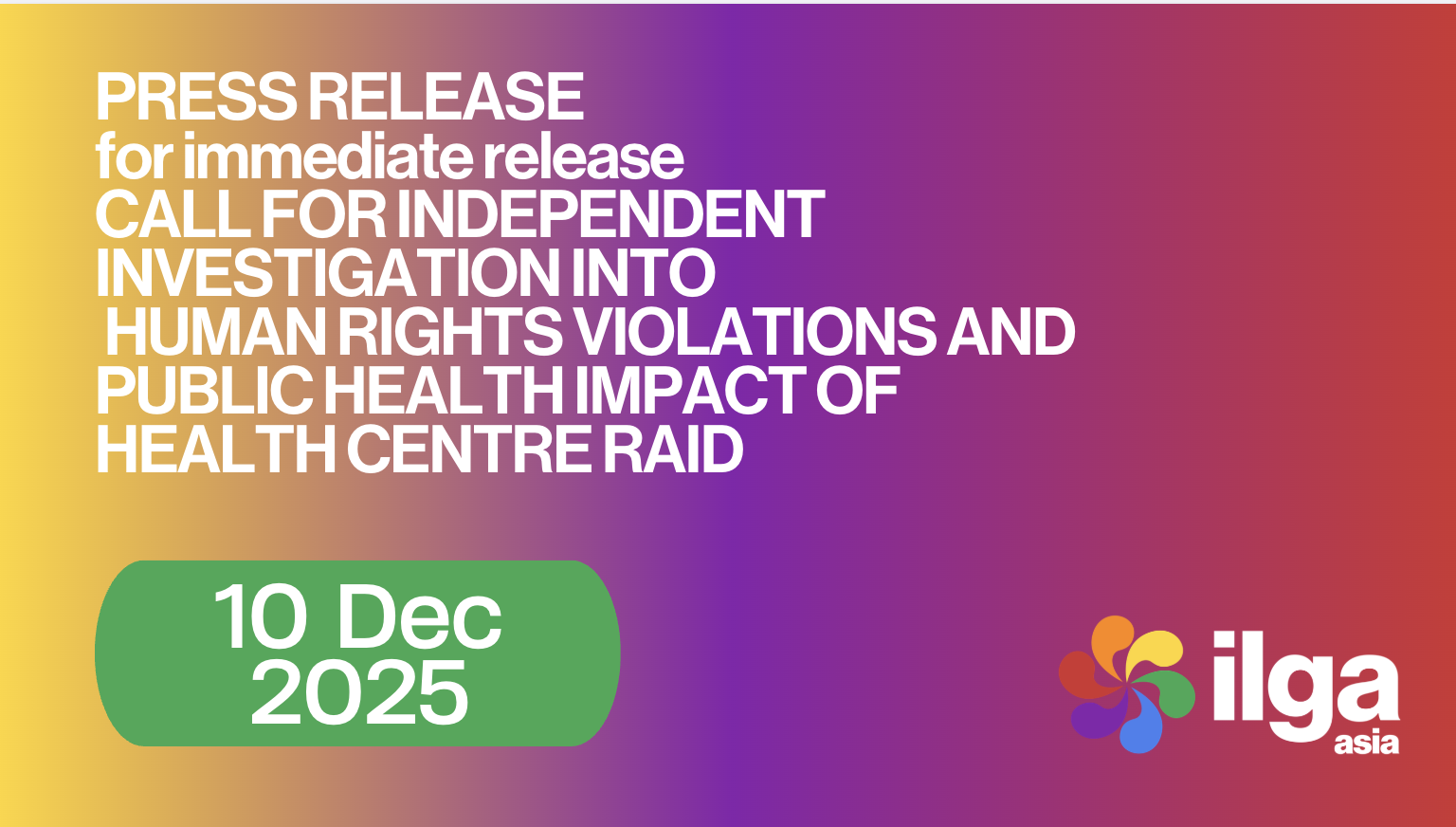
CALL FOR INDEPENDENT INVESTIGATION INTO
HUMAN RIGHTS VIOLATIONS AND PUBLIC HEALTH IMPACT OF
HEALTH CENTRE RAID
Date: 10 Dec 2025
We are alarmed by the many violations of human rights and due process during the raid of Kuala Lumpur health centre Otot2 and the arrest of the 202 men in the premise, conducted by the Royal Malaysia Police (PDRM) with other agencies, including Kuala Lumpur City Hall (DBKL) and Federal Territory Islamic Department (JAWI) on 28 Nov 2025.
Human rights violations
According to documentation by human rights groups, detainees reported serious mistreatment throughout the raid, arrest, and detention. These accounts indicate 11 major human rights violations:
- Violation of right to due process and detainees’s rights;
- Biased and intimidating statement-taking questions and process;
- Poor management of the detainees;
- Poor condition of the detention area, sleep deprivation and access to toilets;
- Lack of adequate food or water for detainees while in police custody;
- Lack of access to medical attention and medicine, as well as forcible disclosure of HIV status;
- Unnecessary physical force and other forms of aggression;
- Verbal and psychological abuse;
- Sexual harassment and degrading treatment of the detainees;
- Unnecessary inspection of phones; and
- Corruption.
These violations highlight serious breaches of constitutionally protected and internationally recognised human rights, and the lack of basic fairness and professionalism expected of law-enforcement agencies.
The treatment of the detainees in police custody violated rules safeguarded under the Body of Principles for the Protection of All Persons under Any Form of Detention or Imprisonment and the Nelson Mandela Rules.
Transparency and accountability of law enforcement
The detainees’ right to dignity was severely violated because of their actual and perceived sexual orientation. We urge PDRM to uphold the rule of law, comply with the Criminal Procedure Code, and conduct all investigations with professionalism and respect for human rights, free from prejudice, moral judgment, or bias based on sexual orientation.
Law-enforcement powers are granted and limited by law; officers must therefore carry out investigations with professionalism and impartiality, while upholding the dignity of detainees, who are innocent until proven guilty according to the law. It is also imperative for the police to perform their duties in a manner that maintains public trust.
We call on the Human Rights Commission of Malaysia (SUHAKAM) and the Ministry of Health (MOH) to launch an immediate, independent, and impartial assessment and investigation into the conduct of the relevant agencies throughout the raid, arrest, processing, and the prolonged detention after the magistrate denied the remand extension on the evening of November 29, 2025.
Impact of the raid on public health progress
The raid resulted in severe public health impact. Many have reported increased strain on their mental health, including suicidal ideation and severe psychological distress. This has severely impacted their ability to perform daily tasks, including eating, working, sleeping, and seeking treatment, among others.
When safer sex tools, such as condoms or Pre-Exposure Prophylaxis (PrEP), are used to insinuate criminal acts, this effectively jeopardises national public health progress.
A previous survey conducted by Justice for Sisters (JFS) revealed that 61% of survey respondents felt unsafe attending government or NGO-organised health programs following the raid of a health event in Kelantan. Meanwhile, UNAIDS’s research indicates that HIV prevalence is 5 to 12 times higher in countries that criminalise and actively prosecute people based on actual or perceived sexual orientation.
The assessment and investigation should also examine the public health and human rights impacts of the raid. We also call on the Ministry of Health (MOH) to review the impact of these enforcement actions on national health policies.
We further call on the media, public, and state actors to refrain from sensationalised reporting, public shaming, witch-hunting, or media trials that fuel discrimination and reinforce harmful stereotypes.
Endorsed by :
ORGANISATIONS BASED IN MALAYSIA
- Justice for Sisters
- JEJAKA
- People Like Us Hang Out! (PLUHO)
- PT Foundation
- North South Initiative
- KLSCAH Youth
- SIUMAN Collective
- MANDIRI
- Sarawak AIDS Concern Society (SACS)
- Life Under Umbrella
- Beyond Borders Malaysia
- Tenaganita
- Yellow House KL
- SEED Malaysia
- Women’s Aid Organisation (WAO)
- Autism Inclusiveness Direct Action Group (AIDA)
- Kolektif Feminis Malaysia
- HUSH Collective
- Persatuan Promosi Hak Asasi Manusia (PROHAM)
- SIS Forum (Malaysia)
- Pertubuhan Kesihatan Dan Kebajikan Umum Malaysia (PKKUM)
- Kuala Lumpur AIDS Support Services Society (KLASS)
- Association of Women Lawyers (AWL)
- Monsters Among Us (MAU)
- KL Queer Space
- Women’s March Malaysia (WMMY)
- All Women’s Action Society (AWAM)
- Greater Equitable Measures (GEM)
- Parti Sosialis Malaysia
- Reproductive Rights Advocacy Alliance Malaysia (RRAAM)
- Pride Borneo
- Legal Dignity
- Suara Rakyat Malaysia (SUARAM)
- Freedom Film Network
- Galen Centre for Health and Social Policy
- Sisters United
- Pride In Research
- Shh…Diam!
- HAYAT
- Refugee Emergency Fund (REF)
- Malaysian AIDS Council (MAC)
- Five Arts Centre
- Kuala Lumpur Men’s Chorus
- Intan Life Zone Welfare Society
- Sarawak Women for Women’s Society (SWWS)
- Persatuan Kesedaran Komuniti Selangor (EMPOWER)
- Women’s Centre for Change, Penang (WCC)
- Pemuda Sosialis
- ReformARTsi
- Gabungan Darurat Iklim Malaysia (GDIMY)
- People Like Us Support Ourselves (PLUsos)
- Family Frontiers
- Aliran
- The Tiada.Guru Campaign
- Federation of Reproductive Health Associations, Malaysia (FRHAM
- Kemban Kolektif)
- Drug Policy Program Malaysia
REGIONAL / INTERNATIONAL ORGANISATIONS
- ASEAN SOGIE Caucus
- APCOM Foundation
- Transhold
- Equals_Id Foundation, Indonesia
- In Defense of Human Rights and Dignity Movement (iDEFEND), Philippines
- True Colors Coalition (TCC), Philippines
- Pesona Bumi Pasundan Foundation (Indonesia)
- Pelangi Nusantara, Indonesia
- ILGA Asia
- Asia Pacific Network for Service Workers (APNSW)
- Sanggar Swara (Indonesia)
- IAS – the International AIDS Society
- Movement for Alternatives and Solidarity in Southeast Asia
- Society For Women Awareness Nepal (SWAN)
APPENDIX
Timeline of key events
28 Nov, Around 8 PM: Joint raid on Otot2; 202 individuals arrested and held overnight, including the owner, staff, and patrons. Detainees were denied timely access to legal counsel and communication with families. Their identities and images were leaked, leading to public humiliation and loss of jobs.
29 Nov, 8.00PM-9.30PM: The police sought 7 days’ remand. Magistrate rejects remand extension for all Malaysian detainees, thus they should have been released promptly. The foreigners were remanded for 2 days under the Immigration Act.
29–30 Nov: Detainees continue to be held. The first Malaysian detainee was released around 7:40–8:00 AM on Nov 30 (10 hours after remand hearing), the last Malaysian detainee at 3:15 PM (19 hours after remand hearing).
Documented Human Rights Violations*
1. Violation of right to due process and detainees’s rights
- Detainees were not informed of charges, rights of legal representation, or remand status.
- Police instructed them to leave key legal sections blank (eg, charges, appointment of lawyers, health issues, next of kin). Threatened with charges for “obstruction” when refusing to sign incomplete forms.
- Telephone access was denied for up to 8 hours or more. Some family members filed a missing persons report.
- Foreign nationals were denied embassy access and translators.
2. Biased and intimidating statement taking questions and process
- Detainees were never told of the charges against them, but the interrogation included leading, intrusive questions about sexual practices and sexual orientation. The police also refused or were very hesitant to make corrections to the statements, and inserted prejudicial and inaccurate wording. Detainees faced intimidation for requesting corrections, including yelling and being charged for obstruction of police duty. The questions appeared to presume guilt of the detainees.
3. Poor management of the detainees
- Forced to sit, stand, and re-queue repeatedly for no clear purpose.
- Overcrowded transport: 30–40 people packed into trucks meant for 20–25.
4. Denial of Toilet Access, Sleep Deprivation & Poor Detention Condition
- Detainees were denied toilet access, told to urinate in bottles that were thrown at them. Some were told to tie their genitals with rubber bands as a “solution”. One detainee was denied access to a toilet even when vomiting. (At IPK KL)
- Detainees were placed in an overcrowded, poorly ventilated room. Detainees were only allowed to use an overflowing toilet, with no toilet paper or functioning flushing water. (At Dang Wangi)
- Prohibited from sleeping; Ordered to sit upright or “massage” person in front to stay awake.
5. Lack of adequate food or water for detainees while in police custody
- The Detainees were only provided extremely limited food and water (e.g. sharing one piece of bread among 3–5 people), and many drank toilet tap water to avoid dehydration. The food was only provided after a person had fainted. Many complain of gastric pains, digestive issues, and health problems following the detention.
6. Lack of access to medical attention and medicine as well as forcible disclosure of HIV status
- At least three medical emergencies happened; the police were unprepared and unequipped.
- One seizure and two cases of severe panic attacks; officers laughed instead of assisting.
- Detainees were forced to verbally disclose their HIV status repeatedly.
- Those with chronic conditions were denied access to regular medication.
7. Unnecessary physical force, aggression, and violence
- During the statement-taking process, officers banged tables, slapped the detainee’s face with paper.
- Detainees reported witnessing physical violence against other detainees during the raid and at IPK KL
8. Verbal and psychological abuse & shaming
- Detainees were called by pejorative terms (e.g. bangang, barua, beruk, bodoh, lancau, pekak) and other insults. Biased and homophobic remarks directed at detainees and bailors.
- Detainees were forced to sit or sleep in a sitting position on hard floors. Foreign detainees were handcuffed and forced to sleep in restraints.
- Following the detentions, the psychological toll is severe and immediate. An alarmingly high number of individuals reported debilitating symptoms of severe psychological distress such as insomnia, heart palpitations, hyper-vigilance, and suicidal ideation. Furthermore, some have entirely lost their ability to work, socialize, or leave home.
9. Sexual harassment & degrading treatment of the detainees
- Officers made explicit comments about genitals and the detainees’s actual or perceived sexual orientation. Flashlights pointed at a detainee’s crotch; mocked by officers.
- One officer held his bare feet close to a detainee’s face in a threatening manner.
10. Unnecessary inspection of phones
- Phones examined without consent; detainees forced to unlock devices using facial recognition.
11. Corruption
- Officers allegedly asked, “What can you give me since I helped you?” Several detainees were asked to pay RM300, told they could “collect it back in three days.”
*Non-exhaustive list. Based on detainee testimonies collected by NGOs, including Justice For Sisters, PLUHO, and JEJAKA.