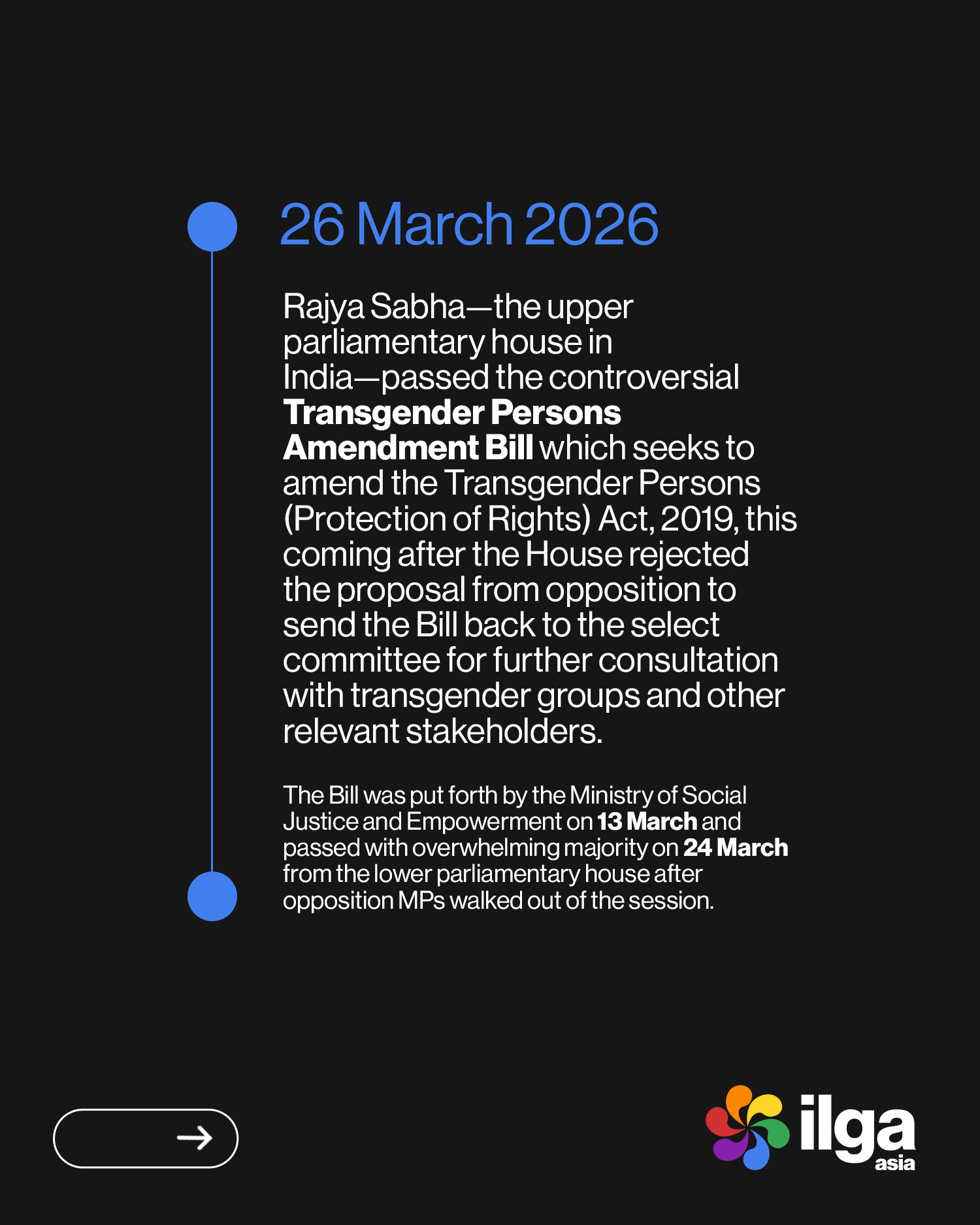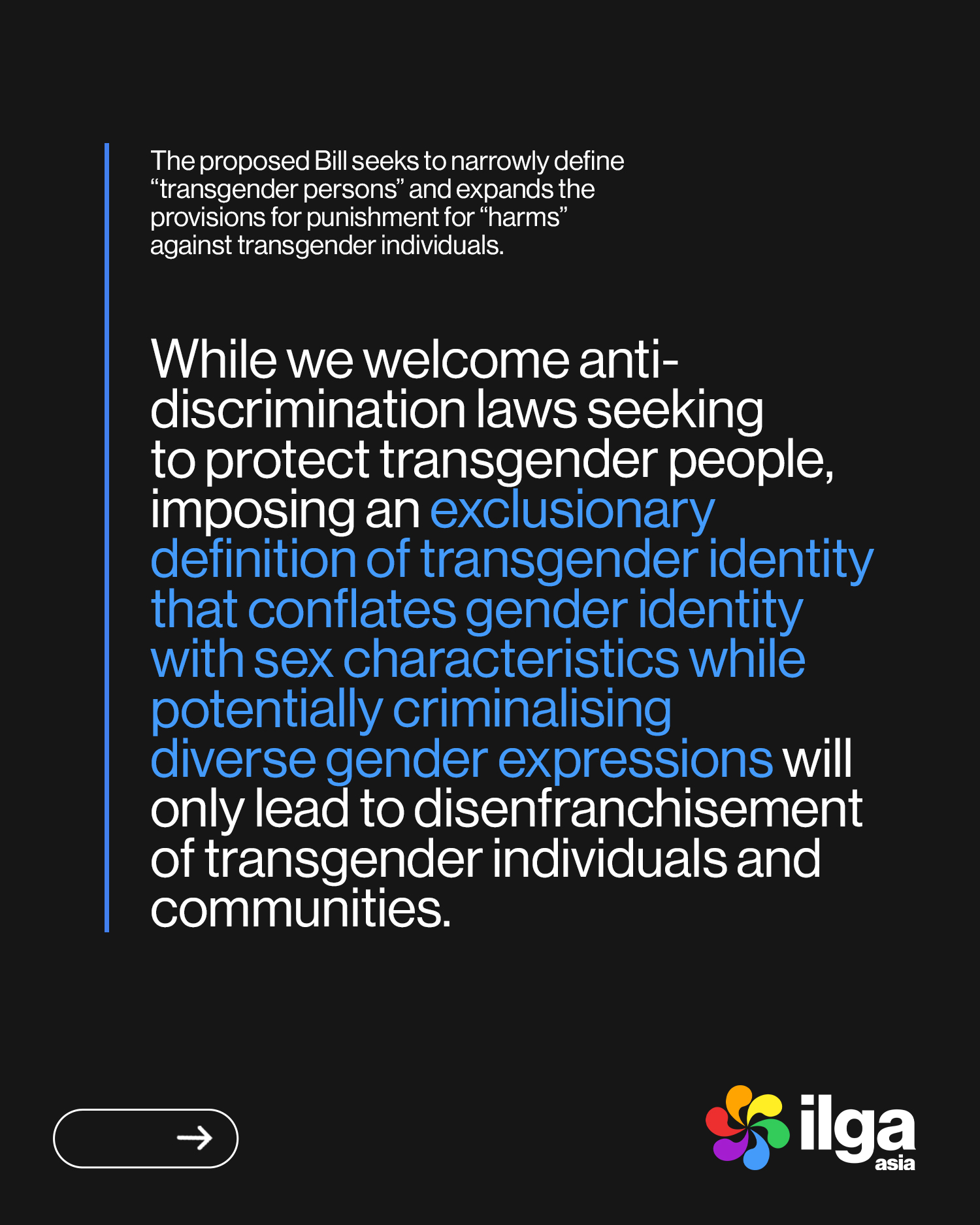

On 26 March 2026, Rajya Sabha—the upper parliamentary house in India—passed the controversial Transgender Persons Amendment Bill which seeks to amend the Transgender Persons (Protection of Rights) Act, 2019, this coming after the House rejected the proposal from opposition to send the Bill back to the select committee for further consultation with transgender groups and other relevant stakeholders. The Bill was put forth by the Ministry of Social Justice and Empowerment on 13 March and passed with overwhelming majority on 24 March from the lower parliamentary house after opposition MPs walked out of the session. The proposed Bill seeks to narrowly define “transgender persons” and expands the provisions for punishment for “harms” against transgender individuals. While we welcome anti-discrimination laws seeking to protect transgender people, imposing an exclusionary definition of transgender identity that conflates gender identity with sex characteristics while potentially criminalising diverse gender expressions will only lead to disenfranchisement of transgender individuals and communities.
The Transgender Persons (Protection of Rights) Act of 2019 was adopted to protect transgender persons from discrimination and unfair treatment. The 2019 Act defined transgender persons as “a person whose gender does not match with the gender assigned to that person at birth” regardless of whether they have received any medical intervention, surgery, or therapy; Section 4 further recognised the right to self-perceived identity for transgender people. The Act, however, did not make a distinction between varied sex characteristics and gender identity and also included intersex persons as well as sociocultural identities like kinner, hijra, aravani and jogta. The definition proposed in the 2026 amendment takes a regressive approach to transgender identity—it further expands on sex characteristics as a criteria for recognition of transgender identity, pathologises transgender children, and explicitly denounces inclusion of “self-perceived sexual identities” as transgender. Transgender people are now required to undergo gender reassignment surgery and be certified by medical authorities—whose qualifications are not clearly defined by the proposed legislation—for legal gender recognition. Such invasive administrative processes are a regressive backslide from the human rights standards articulated in the 2019 Act.
There has been a large backlash to the Bill in India and abroad. The Bill goes against the 2014 Supreme Court verdict in NALSA v. Union of India which held that transgender people are entitled to equal protections under the Constitution of India and have the right to self-identification of gender. On 25 March, ahead of the parliamentary hearing, a Supreme Court-constituted Advisory Committee submitted a resolution requesting the Union government to withdraw the Bill citing the NALSA verdict and for violating the constitutional fundamental rights of transgender individuals. Activists state that the Bill was put forth without consultation with the National Council for Transgender Persons, LGBTIQ organisations, and community groups, and there have been protests in different parts of the country against it. The proposed amendments are concerning as they put the onus on the individual to prove their identity through an invasive medical verification process, which may not be accessible or desirable for every transgender person. The amendments remove the provision for self-identification of transgender people creating risk of surgical gatekeeping, biomedical surveillance into trans bodies, and increased bureaucratic and administrative barriers for transgender people. Furthermore, having criminal liability attached to “compelling such person to assume, adopt, or outwardly present a transgender identity against the will or consent of such person” risks broad interpretation and persecution of gender diverse communities, elders in the sociocultural identities, and organisations working for transgender rights and LGBTIQ advocacy and awareness.
“Why are you so curious to see my sex? O my Anubhava mantapa Parliament what a day you have witnessed!” Akkai Padmashali, a transgender woman and a Gender and Sexuality rights activist calls out the Parliament. “You have kept us out and passed the Bill inside and you are punishing us systematically. The dignity of every intersex and gender minorities communities have been undermined. I am not a ‘he’; I am not a ‘she’; I am not ‘intersex’. Let me decide my identity. You have no right to decide ‘me’. Down with phobic people!”
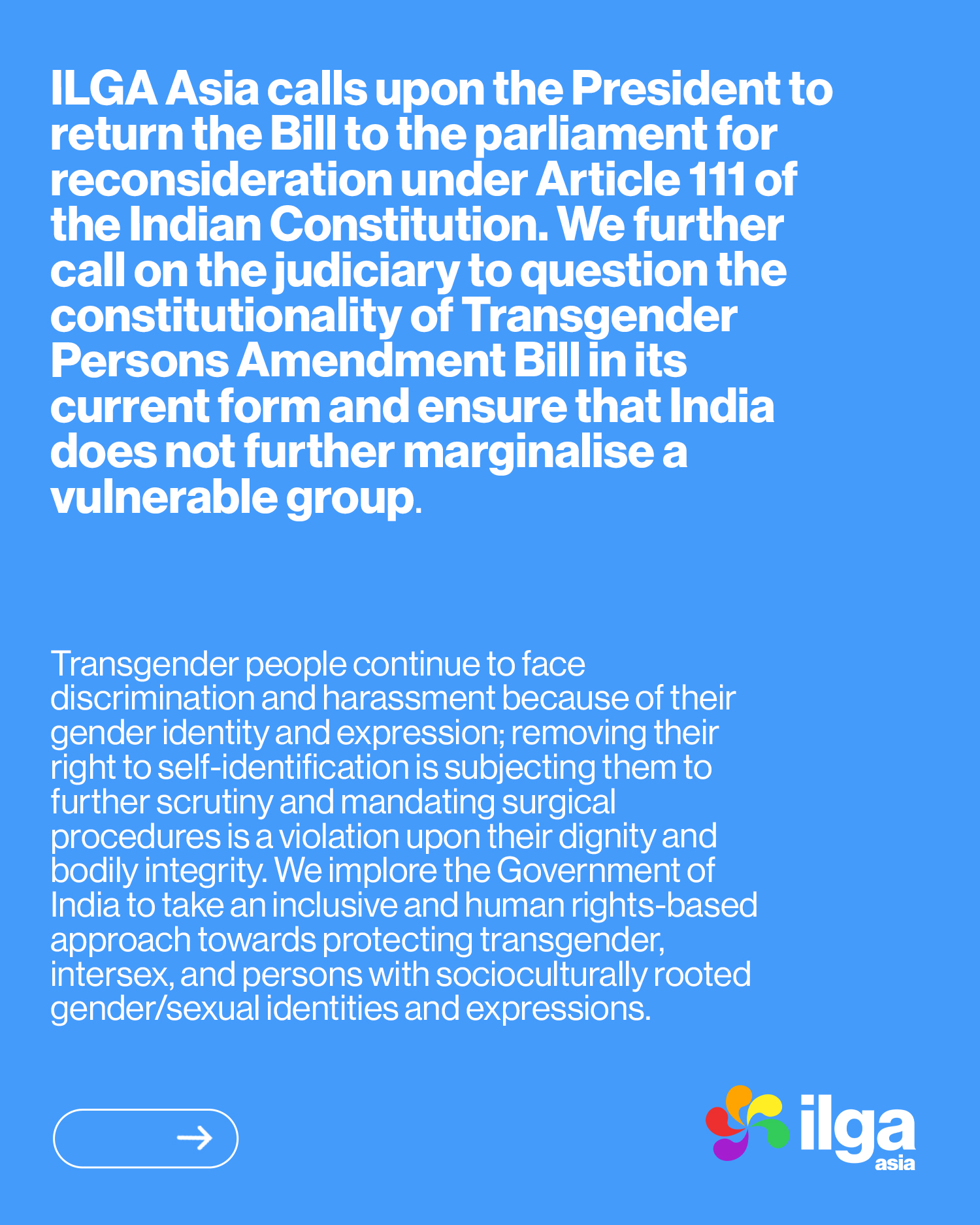
ILGA Asia calls upon the President to return the Bill to the parliament for reconsideration under Article 111 of the Indian Constitution. We further call on the judiciary to question the constitutionality of Transgender Persons Amendment Bill in its current form and ensure that India does not further marginalise a vulnerable group. Transgender people continue to face discrimination and harassment because of their gender identity and expression; removing their right to self-identification is subjecting them to further scrutiny and mandating surgical procedures is a violation upon their dignity and bodily integrity. We implore the Government of India to take an inclusive and human rights-based approach towards protecting transgender, intersex, and persons with socioculturally rooted gender/sexual identities and expressions.